


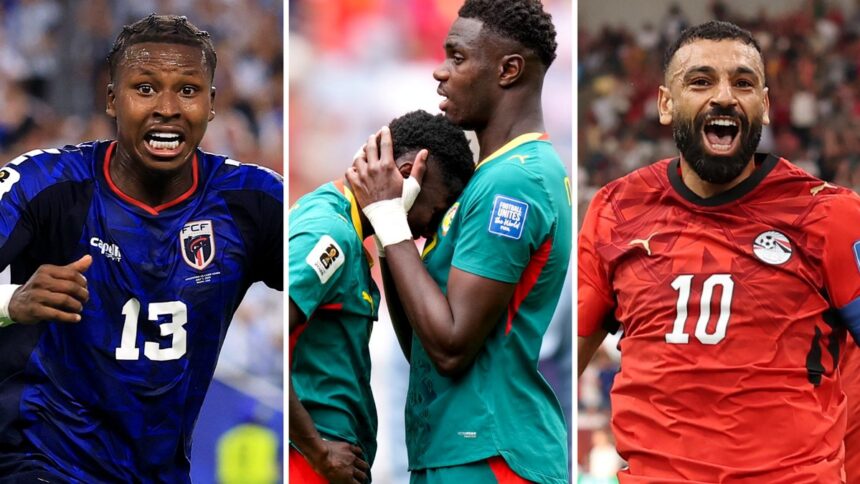
Cape Verde steal the show on World Cup debut
Cape Verde reached the last 32 on their World Cup debut, drawing with Spain, Uruguay and Saudi Arabia in the group stage. The Blue Sharks then pushed defending champions Argentina to extra time before losing 3-2, fighting back from a goal down twice in one of the tournament’s closest calls.
Goalkeeper Vozinha became a viral sensation after a string of saves against Spain and Argentina. His Instagram following climbed from 50,000 to more than 29 million by the end of the finals.
The 40-year-old’s sudden fame extended beyond football when a newly discovered species of sea slug was named after him. Defender Roberto ‘Pico’ Lopes said the islanders showed they are “more than capable” of competing with the world’s elite.
“We’ve put ourselves on the map,” Lopes said. “We’re a small nation but with big hearts and we showed what is possible – and if you believe, you can achieve.”
Morocco lead Africa into the last eight
Morocco became the first African side to reach successive quarter-finals. France again ended their run, as the Europeans had in 2022.
The Atlas Lions played a more expansive style under Mohamed Ouahbi, who replaced Walid Regragui. Eighteen-year-old midfielder Ayoub Bouaddi caught the eye during their run to the last eight.
“We have a young team who want to grow, who will continue to do so. We have talented players who will enable us to grow,” Ouahbi said.
Late collapses cost five African sides
Senegal led Belgium 2-0 after 85 minutes of their last-32 tie. The Teranga Lions lost 3-2 to a 125th-minute penalty, the latest winner in World Cup history.
Egypt led Argentina 2-0 in the last 16. Enzo Fernandez’s 92nd-minute header made it 2-2 and eliminated the Pharaohs.
DR Congo and Ivory Coast both conceded 86th-minute winners in the last 32. Canada scored in the second minute of added time to beat South Africa in the same round.
Algeria and the Ivorians also conceded injury-time goals when close to famous group-stage results. Dr Nikita Rowley, a chartered psychologist and course director for sport and exercise psychology at Coventry University, said the pattern was not a trend.
“I wouldn’t say it was a trend. I think it’s just unlucky,” Rowley said. “Every team is more susceptible to mistakes in the closing stages of a match. By that point players are experiencing both physical and cognitive fatigue.”
Rowley added that cognitive fatigue can affect attention, decision making and communication, making lapses more likely. “The closer you get to something historic, the more psychologically demanding it can become,” she said.
Firsts and group-stage progress
Africa sent 10 teams to the expanded 48-team World Cup. Nine advanced from the group stage, and Confederation of African Football boss Patrice Motsepe said they had made the continent’s 1.6 billion people proud.
Egypt and DR Congo recorded their first World Cup wins. Cape Verde, Ivory Coast and South Africa reached the knockout stage for the first time.
Morocco were the only side to reach the quarter-finals. Gambian coach Mattar M’Boge, who works in talent identification for Fifa, said most African players lack experience in high-stakes games.
“The reality is that the vast majority of the players in African national teams are not used to these high-stakes games,” M’Boge said. “The Europeans and the South Americans have advantages because they’re playing more games.”
Tunisia and Ghana fall short
Tunisia were the big disappointment of the finals. They sacked Sabri Lamouchi after a 5-1 opening loss to Sweden in Group F.
The two-time Afcon winner Herve Renard replaced him but lost 4-0 to Japan. Renard’s side then fell 3-1 to the Netherlands.
Ghana reached the last 32 for the first time since 2010. The Black Stars had no shots on target against Colombia and only four across four games under Carlos Queiroz, with only Iraq attempting fewer.
Visa barriers and officiating controversy
Supporters from Ivory Coast and Senegal were barred from the recommended US visitor visa. Algeria, Cape Verde and Tunisia were initially asked for deposits up to $15,000 for entry.
Somali referee Omar Artan was turned away five days before the finals despite holding papers. Uefa appointed him to the Super Cup between PSG and Aston Villa.
Fifa was criticised over Artan’s exclusion and a suspended ban for US striker Folarin Balogun. Caf did not publicly denounce the governing body on either issue.
President Gianni Infantino has since raised the prospect of a 64-team World Cup that would grant Africa more places.