


England’s semi-final collapse deepens a 60-year pattern
England lost 2-1 to Argentina in the World Cup semi-final after a desperate late collapse, missing their first men’s final since winning the tournament at Wembley in 1966. The defeat extends a catalogue of disappointment now stretching to 60 years and adds to successive Euro final losses and the 2018 World Cup semi-final defeat by Croatia.
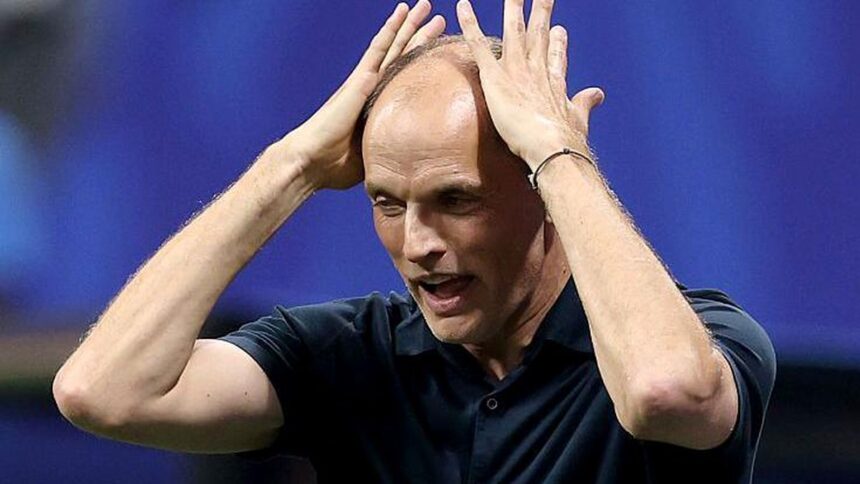
Thomas Tuchel had led England to their second World Cup semi-final in three tournaments, beating Norway 2-1 in the quarter-final. After that match he gave an outspoken interview, was highly critical of the performance, and later suggested limits to the team’s natural game.
He claimed you could bottle up England’s mentality and sell it, yet what you could not sell is their big-game reliability when it matters. Tuchel later suggested that “it’s maybe not in our DNA …to control the game and ball”.
“It’s maybe not in our DNA like it is in the Spanish DNA or Argentinian or Brazilian DNA to take the ball, control the game and the ball, which is also a big problem,” he said.
“I still think we can show how good football players we are. I think that is still in us, as I see it in training and in every camp.” The late collapse against Argentina raised familiar questions about a string of near misses.
Kane and Bellingham carried the burden
England’s World Cup campaign was led by the world-class quality of captain Harry Kane and Jude Bellingham. The Three Lions have scored 14 goals so far in the tournament.
Kane and Bellingham accounted for 12 of those goals, with six each. Marcus Rashford and Anthony Gordon supplied the other two between them.
When England trailed DR Congo in the last 32, Kane’s late double rescued them from the precipice. Bellingham was the saviour with two goals after they fell behind against Norway in the quarter-final.
Tuchel was hampered by Arsenal duo Declan Rice and Bukayo Saka struggling with illness and injuries, reducing the effectiveness of a pair he would have counted on. John Stones remains a class act but is now 32, and elsewhere England are solid and reliable rather than spectacular.
England do not have class stamped right through the side like World Cup finalists and European champions Spain, or France with their stellar array of attacking talent. They lack the in-built desire and refusal to be beaten of Argentina, helped along by the enduring genius of Lionel Messi.
Their campaign has been restricted, and on occasion rescued, by existing on moments. It has not been characterised by good performances.
England deserve huge credit for one of their great World Cup wins when they came through the Azteca cauldron to beat Mexico in Mexico City. Only if you count 30 minutes in the second half of the 4-2 win against Croatia in their opening group game have they actually played well.
They were only 15 minutes away from humiliation against DR Congo until Kane saved them. For all the experience in the team, and even with quality such as Rice and Elliot Anderson in midfield, Tuchel’s side lack an ability to control possession and dictate terms against quality sides.
The possession problem laid bare
The clearest damning statistic came in the semi-final. Anthony Gordon put England ahead after 55 minutes, and Lautaro Martinez won it for Argentina three minutes into stoppage time.
Between those two moments, England held just 12% possession. Tuchel said ball possession “plays a crucial role” and built his England using a Premier League template in style and system.
That template uses a back four. Midfield anchors sit in Rice and Elliot, with Bellingham at ’10’ and two orthodox wide men.
All very well in the Premier League, but at elite World Cup level it is clear you need more. England lack an ability to control tempo against quality sides.
Croatia passed them off the pitch in Moscow in the 2018 semi-final. Tuchel’s tactical retreat as England led this semi-final drew the sort of criticism Southgate would have faced.
Tuchel was meant to be the anti-Gareth Southgate, even though Southgate had led England to two Euro finals and a World Cup semi-final. The German was supposed to be the elite coach who would make the difference when it mattered.
Instead, with England leading a semi-final and in control, Tuchel went into the sort of tactical retreat that would have had many wanting Southgate run out of town. His England effectively reached par by getting to the semi-finals, but par does not win big prizes.
Selection choices under scrutiny
Tuchel went for a pragmatic squad as opposed to one where he went straight for quality. Trent Alexander-Arnold was exiled long before the squad was named.
Cole Palmer and Phil Foden were left out, admittedly after poor seasons with Chelsea and Manchester City. Morgan Gibbs-White was ignored after a fine campaign at Nottingham Forest.
At times England lacked the possession control of Crystal Palace’s Adam Wharton, a four-cap rookie who won the FA Cup and Conference League with maturity beyond his experience. The midfield base of Rice, Anderson, and Bellingham is hard to argue with, but Tuchel must find something different before Euro 2028.
England have physicality and no little skill, but apart from Kane and Bellingham they have little other X-factor for the big games. The concern for the Football Association is they have now tried everything.