


England’s World Cup exit still leaves reasons for optimism
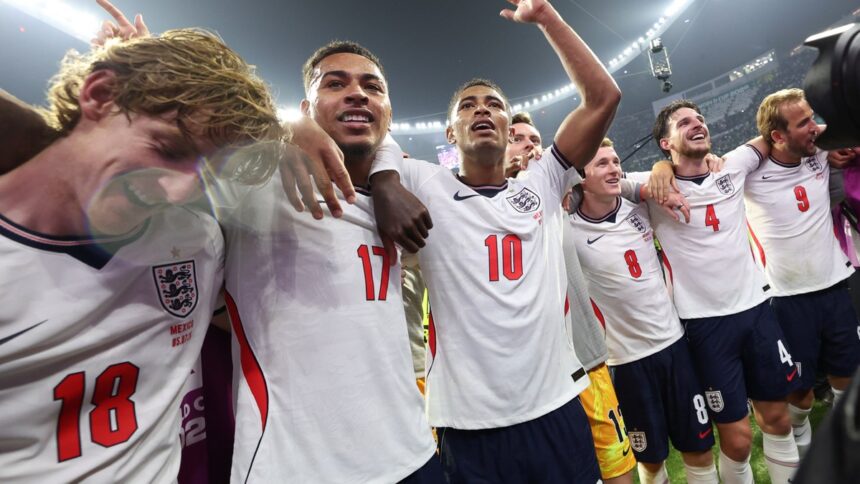
A semi-final defeat to Argentina at the 2026 World Cup extended England’s wait for a major trophy, but the loss does not erase clear signs of progress. Despite the pain of another near miss, the squad produced individual brilliance, adapted to brutal conditions, and revealed depth that could serve them at Euro 2028.
Kane and Bellingham lead the scoring charts
Harry Kane and Jude Bellingham have scored 12 goals between them at this World Cup, giving England two genuine Golden Boot contenders. Kane arrived in the United States after averaging a goal every 66 minutes for Bayern Munich this season.
He posted two goals in the opening game against Croatia. Kane then added four more as England progressed through the tournament.
Bellingham was a quieter figure at Real Madrid following a shoulder operation, yet he enters the third-place play-off level with Kane on six goals. Either could claim the Golden Boot by matching or bettering Kylian Mbappe and Lionel Messi’s total of eight in Saturday’s match against France.
Both rescued England at critical moments. Kane’s brace against DR Congo avoided a round-of-32 exit, and Bellingham’s double against Norway sealed a semi-final spot. Kane has not committed to the 2030 World Cup, but the pair should appear together once more at the 2028 Euros.
A new era of consistent deep runs
Reaching the semi-final of a major tournament has become an expectation for England, a sharp change from recent history. Before the 2018 World Cup semi-final, England had not gone beyond the quarter-finals since Italy 1990.
They had only reached the quarter-finals once since the 1996 semi-final loss to Germany, before the 2020 Euros final loss to Italy. The lack of silverware remains, yet reaching a semi-final or final in four of the last five major tournaments marks a major upturn.
England lost back-to-back European finals in 2021 and 2024. The 2018 World Cup semi-final exit also stings, but those results confirm sustained progression.
Adapting to hostile conditions
Heat, humidity, lightning and rain shaped the 2026 World Cup, and England handled them better than many opponents. They benefited from a roofed, air-conditioned stadium in Atlanta against DR Congo but faced stifling humidity and high temperatures in Miami against Norway.
The altitude and atmosphere of Mexico’s Azteca for the round-of-16 tie were seen as major hurdles, yet England won 3-2 and never appeared overwhelmed. Preparation camps helped, but the players’ mental and physical strength in conditions suited to others should benefit them at the more familiar Euro 2028 settings.
Spence justifies Tuchel’s selection
Thomas Tuchel’s May squad omitted Harry Maguire, Cole Palmer and Trent Alexander-Arnold, but Djed Spence’s inclusion proved fruitful. The Tottenham defender, whose club fights relegation, drew praise from fans and pundits for key tackles in the Argentina loss.
Spence’s solid displays show England can find squad depth beyond headline stars. Defenders rarely earn the acclaim of Golden Boot candidates, but a tournament win will require such contributions.
Young prospects ready to step up
At 32, Kane cannot rescue England indefinitely, and other veterans may soon exit, but young talent offers a rebuild path. Rio Ngumoha impressed in his debut Premier League season and was man of the match on his England debut at 17 against New Zealand.
Max Dowman became the youngest Premier League goalscorer at 16 in March and its youngest winner in May. Bellingham, Elliot Anderson, Jarell Quansah, Morgan Rogers and James Trafford are all 23 and will be 27 at the next World Cup, statistically a prime age to win it.
What comes next
England meet France for third place on Saturday in Miami before the Nations League begins on 24 September as a chance to build on positives. Euro 2028 follows on home soil, co-hosted by England, Scotland, Wales and the Republic of Ireland.
Many fans will dare to dream of a third consecutive final with a different outcome after what they saw this summer.