


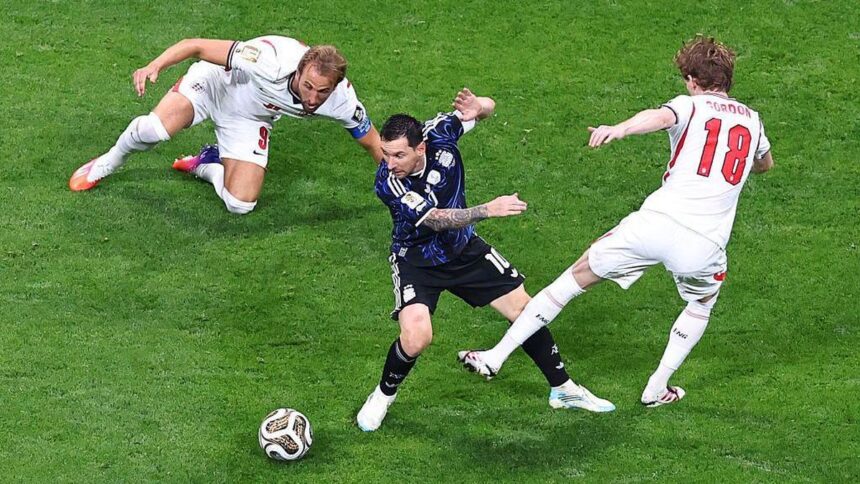
Messi’s Spatial Control Undoes England in World Cup Semifinal
Argentina beat England 2-1 in the World Cup semifinal in Atlanta after trailing to Anthony Gordon’s 55th-minute goal. Enzo Fernandez equalised in the 85th minute and Lautaro Martinez headed a stoppage-time winner from Lionel Messi’s cross. The comeback was built on Messi’s manipulation of England’s shape and Thomas Tuchel’s in-game changes rather than raw athleticism from the 39-year-old, and the result put Argentina into a third World Cup final.
England’s Early Press Stifles Argentina
England entered the match intent on using their physicality against an older Argentina side, pressing high through wingers Gordon and Morgan Rogers. Harry Kane and the midfield took a man-to-man approach centrally, with Elliot Anderson paired against Messi.
Anderson was snappy in his duels and intercepted a pass intended for the Argentina captain in the 10th minute. Jude Bellingham sat deeper than expected to track Fernandez, and England’s midfield trio stifled Argentina early. Argentina’s central passes fell into England’s trap, and Emiliano Martinez went long under pressure.
Messi, Fernandez and Mac Allister gradually grew into the game as England’s energy faded. Messi began taking deeper positions that forced Anderson to decide how far to follow him.
Messi Adapts to Anderson and Exploits Space
Messi used a walking pace as deception before bursting into sudden movement toward the ball. As England’s press tired, Argentina moved the ball up the pitch as a unit.
Messi started using Anderson’s aggression against him by holding the ball to draw the 23-year-old out. He then flicked it into the space Anderson had vacated for team-mates.
For Fernandez’s equaliser, Messi played a one-two from a short corner and dribbled infield. He drew Anderson and Djed Spence toward him before releasing the pass to Fernandez, who struck with clinical accuracy beyond Jordan Pickford.
Between Gordon’s goal and the equaliser, England had just 12% of the ball. They defended deep for most of the second half.
Tuchel’s Shift to a Back Five Plays Into Messi’s Hands
Trailing and under sustained pressure, Tuchel moved to a 5-3-2 to match Argentina’s box numbers. The formation left the three central midfielders unable to cover the pitch’s width.
Messi recognised this and operated closer to goal in a deeper, right-sided role. He held unmarked space that either let him receive freely or dragged defenders out of shape.
Messi also exploited Bellingham’s tendency to be caught high or drawn to the ball. He held position in the space behind the midfielder on the right.
On the flank, Messi and a team-mate were often two against two. If both the winger and full-back joined Messi, Argentina created a three-against-two overload when Bellingham had not come across.
After Rice was substituted for Nico O’Reilly, England moved to 5-4-1. Bellingham dropped into an unfamiliar holding role and struggled with vertical distances.
He gave Fernandez time to shoot from distance before the corner that led to the equaliser. Bellingham’s deep position afforded the Argentine the space to attempt the effort under little pressure.
Scaloni and Messi Reshape the Attack
By flipping Fernandez and Mac Allister and introducing Nico Gonzalez, Lautaro Martinez and Rodrigo de Paul, Scaloni and Messi created reliable right-wing access. They supplied crosses and aerial threats for the best part of half an hour.
With England’s starters fatigued and out of position, Argentina produced what many would consider their best attacking period of the tournament. The semifinal victory secured their place in a third World Cup final.