


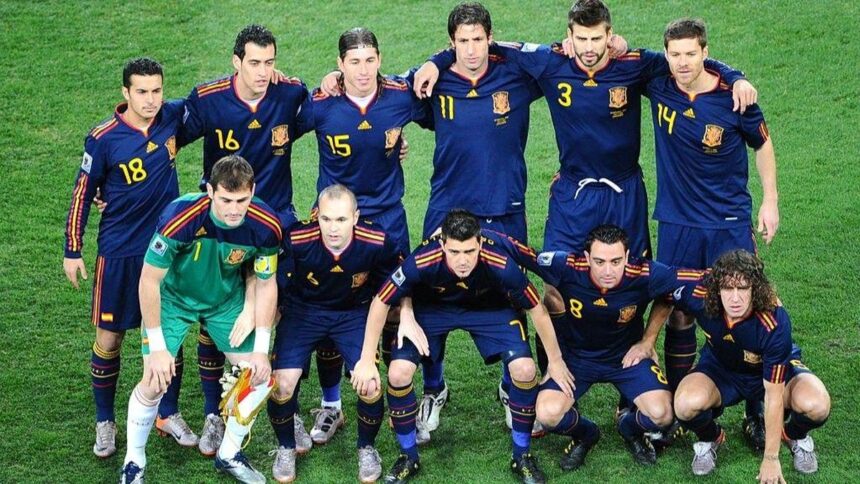
Spain return to the World Cup final with a new generation
Luis de la Fuente’s Spain side will chase a second World Cup title on Sunday, 19 July, 16 years after the golden generation beat the Netherlands in extra time through an Andres Iniesta winner in 2010. The current team reached the final by beating France in Tuesday’s semi-final and carries a less familiar but equally efficient profile than the star-laden 2010 squad.
Both sides arrived at their World Cups as European champions from two years earlier. Only three of the 2010 starting XI had missed the 2008 Euros, while only two players who started the semi-final against France were absent from the Germany 2024 winning squad.
Spain had not won a World Cup knockout game since the 2010 triumph until this run began. De la Fuente’s men have matched Italy’s world-best mark of 37 matches unbeaten, though that sequence excludes a penalty shootout defeat by Portugal in last year’s Nations League final.
This Spain side are the first team to keep six clean sheets at a single World Cup. Their 26-player squad averages an older age than Vicente del Bosque’s 2010 group at 27.8 compared with 26.7, but with far less international experience at 33 caps on average against 56.
How the line-ups compare
Spain’s starting XI for the 2010 final averaged 59 caps, while Tuesday’s line-up averaged 44 caps. The contrast runs through every position on the pitch.
Goalkeeper
Casillas was only 14 days older than Unai Simon when he played in the World Cup final. Casillas remains Spain’s second most-capped player after Sergio Ramos, while Simon has set the goalkeeper record for most consecutive World Cup games without conceding in regulation play with six, a run that includes one match from the 2022 World Cup.
Full-backs
Sergio Ramos and Joan Capdevila started in 2010, with Ramos winning 28 major trophies mostly at Real Madrid and Capdevila earning Euros and World Cup medals at left-back. Pedro Porro and Marc Cucurella, after struggling seasons at Tottenham and Chelsea, have excelled in North America but hold fewer caps than either 2010 full-back held in the final.
Centre-backs
Puyol and Pique conceded just two goals in South Africa as the defensive backbone. Aymeric Laporte and Barcelona teenager Pau Cubarsi have conceded one fewer so far and nullified Kylian Mbappe, Michael Olise and Ousmane Dembele in the semi-final.
Central midfield
Sergio Busquets and Xabi Alonso controlled the 2010 midfield in front of the backline. Rodri and Fabian Ruiz have matched them in 2026, with Rodri making more passes than anyone else and the joint second-most tackles.
Attacking midfield
Xavi and Iniesta formed one of football’s best midfield partnerships, with Xavi’s corner setting up Puyol in the 2010 semi-final and Iniesta scoring the famous final winner. Dani Olmo and Alex Baena have shown quality in their places without that historical pedigree.
Forwards
David Villa scored five goals in 2010 to finish joint top scorer with Diego Forlan, Wesley Sneijder and Thomas Muller, supported by Pedro with eight caps and Fernando Torres off the bench. Lamine Yamal has one goal so far but spearheads the attack alongside Mikel Oyarzabal, who has five goals at this World Cup and a one-in-two scoring record for Spain.